Congkak
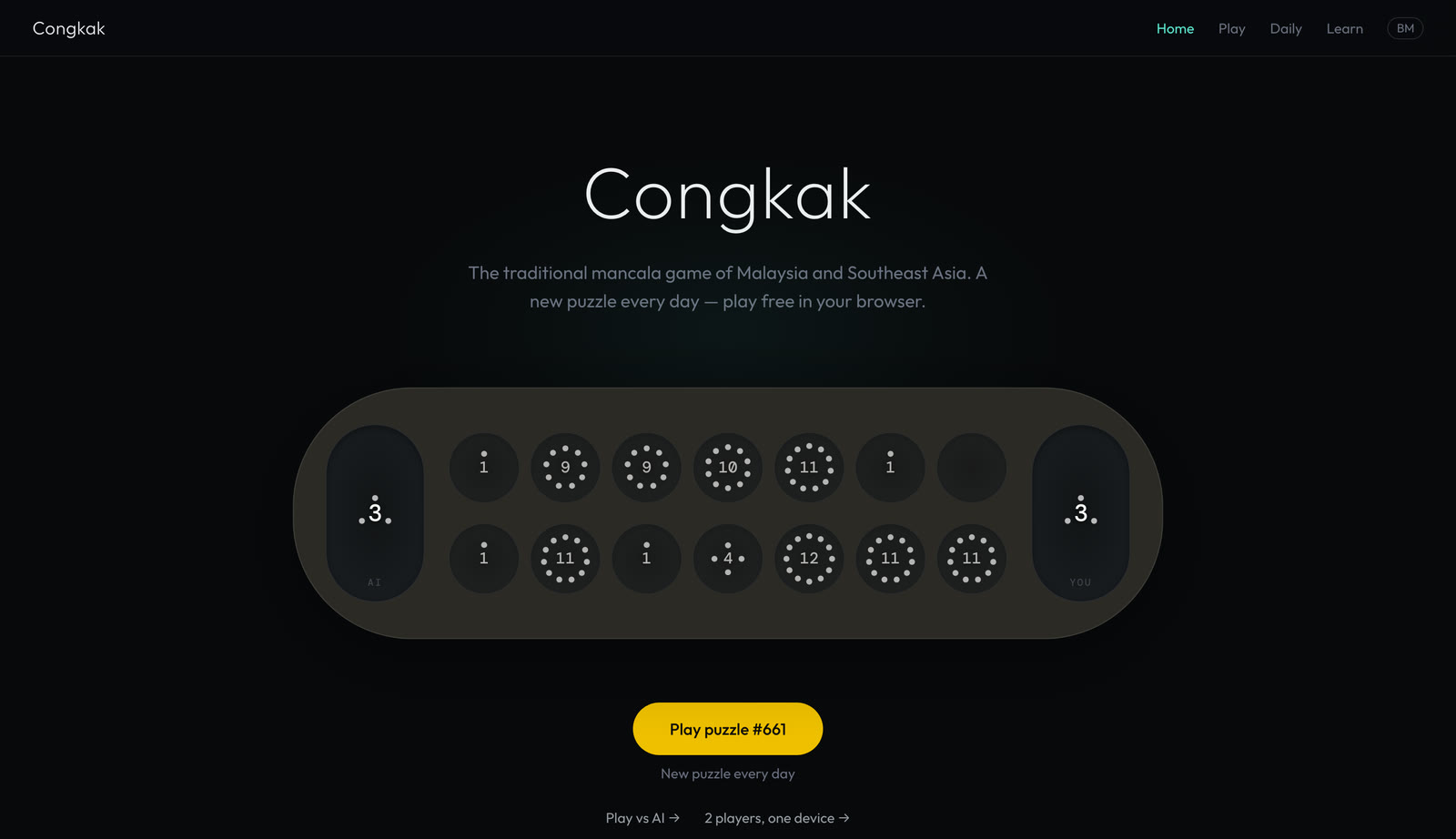
Congkak is the Malaysian mancala game, played in the browser. You can play against the computer at three levels, play a friend on the same device, or try the daily puzzle, which starts from a mid-game position and is the same for everyone. The site also has pages on the rules, strategy and history of the game, and a full Malay version.
Free in the browser, no download or sign-up.
How to play Congkak
These are the rules as this game plays them. They are also on the site’s rules page, with diagrams.
- The board has two rows of seven houses and a storehouse at each end. You own the row nearest you and the storehouse on your right.
- Every house starts with 7 seeds, 98 seeds in all, and both storehouses start empty. Player 1, on the bottom row, moves first.
- On your turn, take all the seeds from one of your houses and drop them one at a time into the next holes, counter-clockwise: along your row, into your storehouse, then along your opponent’s row. You skip your opponent’s storehouse.
- If your last seed lands in your own storehouse, you take another turn, and this can happen several times in a row.
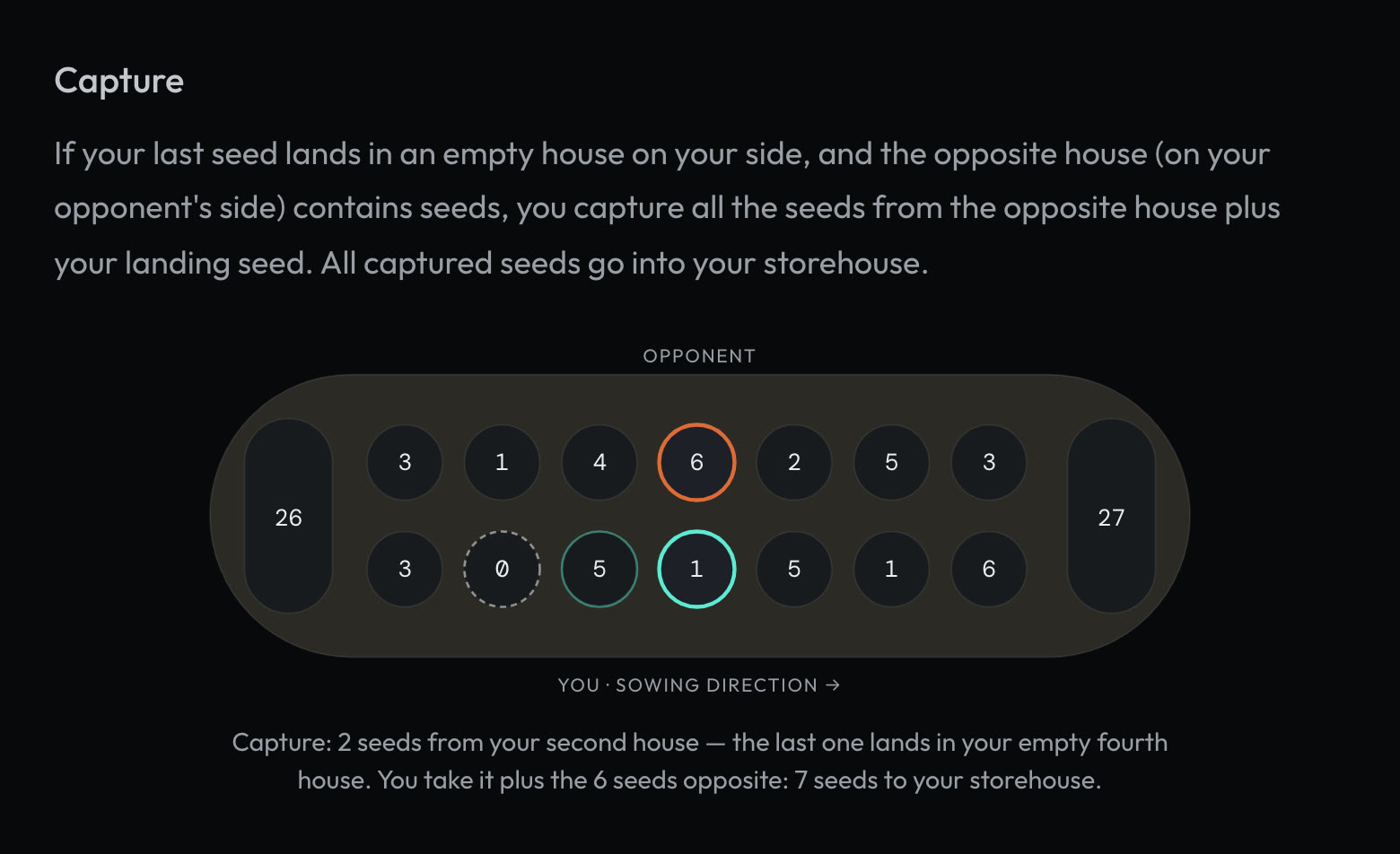
- If your last seed lands in an empty house on your side and the house opposite has seeds, you capture them. Those seeds and your last seed go into your storehouse. If the opposite house is empty, nothing is captured.
- If your last seed lands anywhere else, your turn ends.
- The game ends as soon as one player has no seeds left in their houses. The other player puts the seeds left on their side into their own storehouse, and the player with more seeds in their storehouse wins. Equal totals are a tie.
Many traditional rule sets use relay sowing, where you pick up the seeds in the house your last seed lands in and keep going. This game doesn’t: the turn ends there. Traditional games also often start with both players sowing at the same time, but here the players take turns from the first move. With these rules the game is close to Kalah, played with more houses and more seeds.
Playing a move
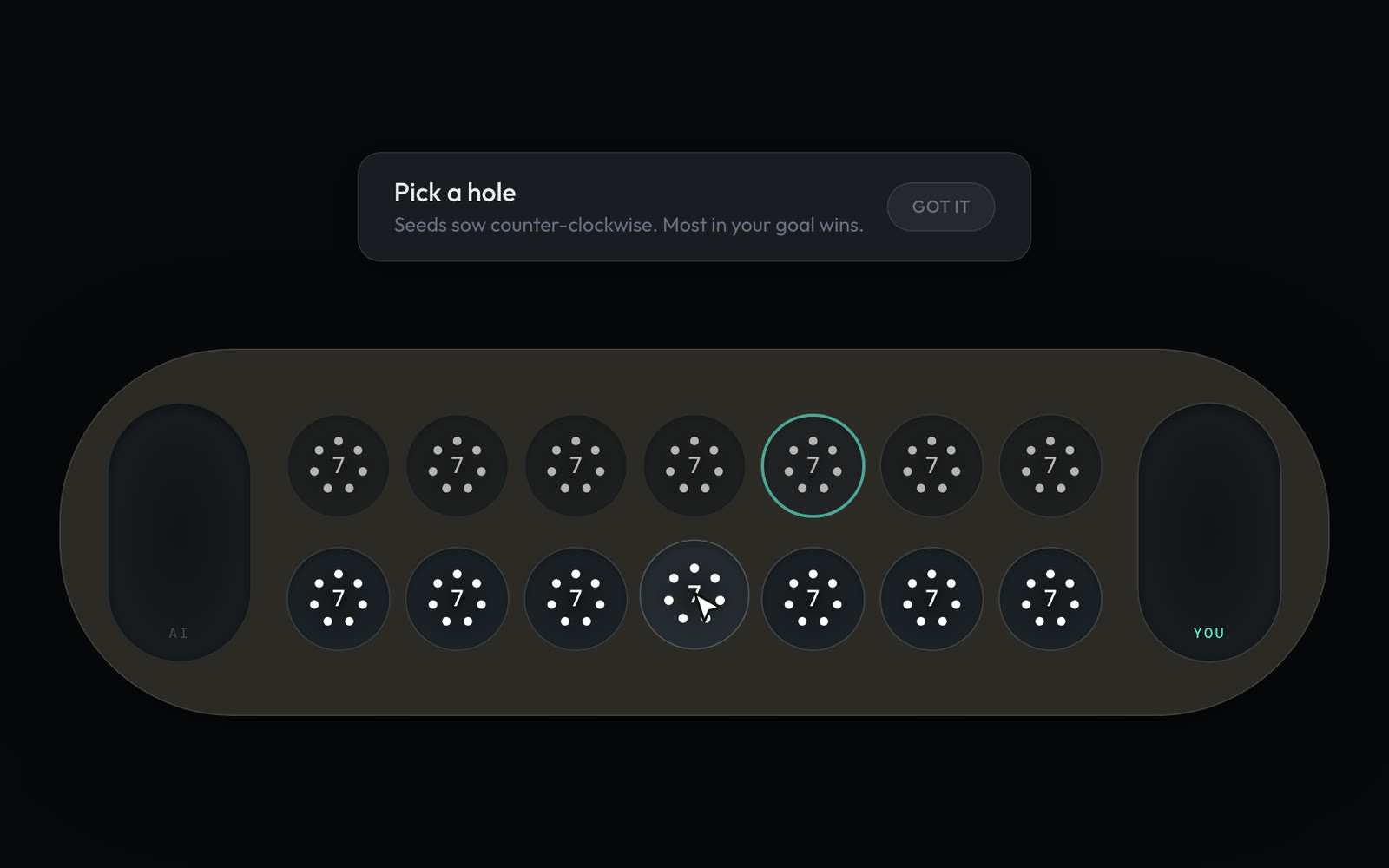
Your houses light up when it is your turn. When you point at one of them, the hole where the last seed would land is outlined, and if the move would capture, the house you would capture from is marked as well. On a touchscreen, the first tap shows this preview and a second tap on the same house plays it. The seeds are then dropped one hole at a time.
In your first game, short tips above the board explain each rule as it becomes useful: how to pick a house, then extra turns, then captures. Messages such as “Go again!” and “Captured 7 seeds!” appear when they happen. You can pause a game, restart it, or go back to the menu.
Playing against the computer
Play vs AI has three levels: Easy, Medium and Hard. Each game, a coin toss decides whether you are Player 1 and move first or Player 2. The computer waits between 1.6 and 2.4 seconds before it moves.
The computer looks one move ahead. For each move it can make, it works out the result and gives it a score: 3 points for each seed added to its storehouse, 20 points for an extra turn, 15 points for each seed captured, and 2 points for each house it could play next if it moves again. It does not look at how you might reply. On Hard it always plays the move with the highest score. On Medium it plays a random move 30% of the time, and on Easy 70% of the time.
2 Players is for two people taking turns on the same phone, tablet or computer. The storehouses are labelled P1 and P2.
The daily puzzle
The daily puzzle is a game against the Medium AI that starts from a mid-game position. Each position is made by playing eight random moves from the start. The rest of the game was then simulated with the Hard AI’s choice of move for both sides, and only positions that Player 1 won in that simulation are used. You always play Player 1 and move first.
Everyone gets the same puzzle, and a new one starts at midnight UTC. The puzzles are numbered from 1 January 2025, so 23 October 2026 is puzzle #661, and there are 3,650 of them. You get one try a day.
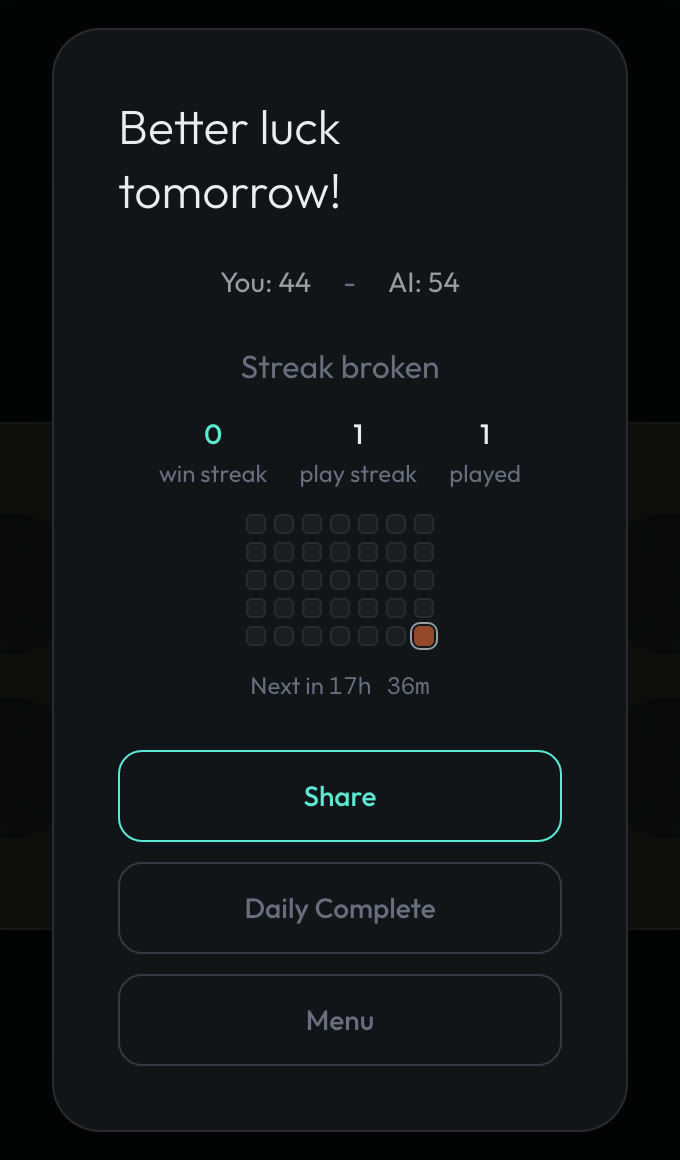
After the game, the results show the score, your win streak (days in a row you won), your play streak, the number of puzzles played, a calendar of the last five weeks and a countdown to the next puzzle. Share sends or copies the puzzle number, a score bar, the score and your streak. You can also add a daily reminder to your calendar, or add the site to your home screen, where it also works offline. Streaks and results are kept in your browser.
Rules, strategy and history pages
The Learn menu has three guides. The rules page covers the board, setup, sowing, extra turns, captures and the end of the game, with four board diagrams and answers to common questions. The strategy guide covers counting ahead, chaining extra turns, setting up captures and common mistakes. The history page covers how the game spread through Southeast Asia and its names in other countries, such as dakon in Java and sungka in the Philippines.
The page for teachers has a 20-minute lesson plan and discussion questions, and the rules page prints as a black-and-white handout.
Malay, e-ink and Chrome versions
The whole site is also in Malay at congkak.chyuang.com/ms/, including the game, the daily puzzle and the rules, strategy, history and teachers’ pages. The BM button in the menu switches language.
An e-ink version for Boox, Kindle and Kobo readers is pure black and white, with no animations and no sound, and has the daily puzzle and free play. Congkak is also a Chrome extension on the Chrome Web Store.
More games
All games →