IndyCar Points Calculator
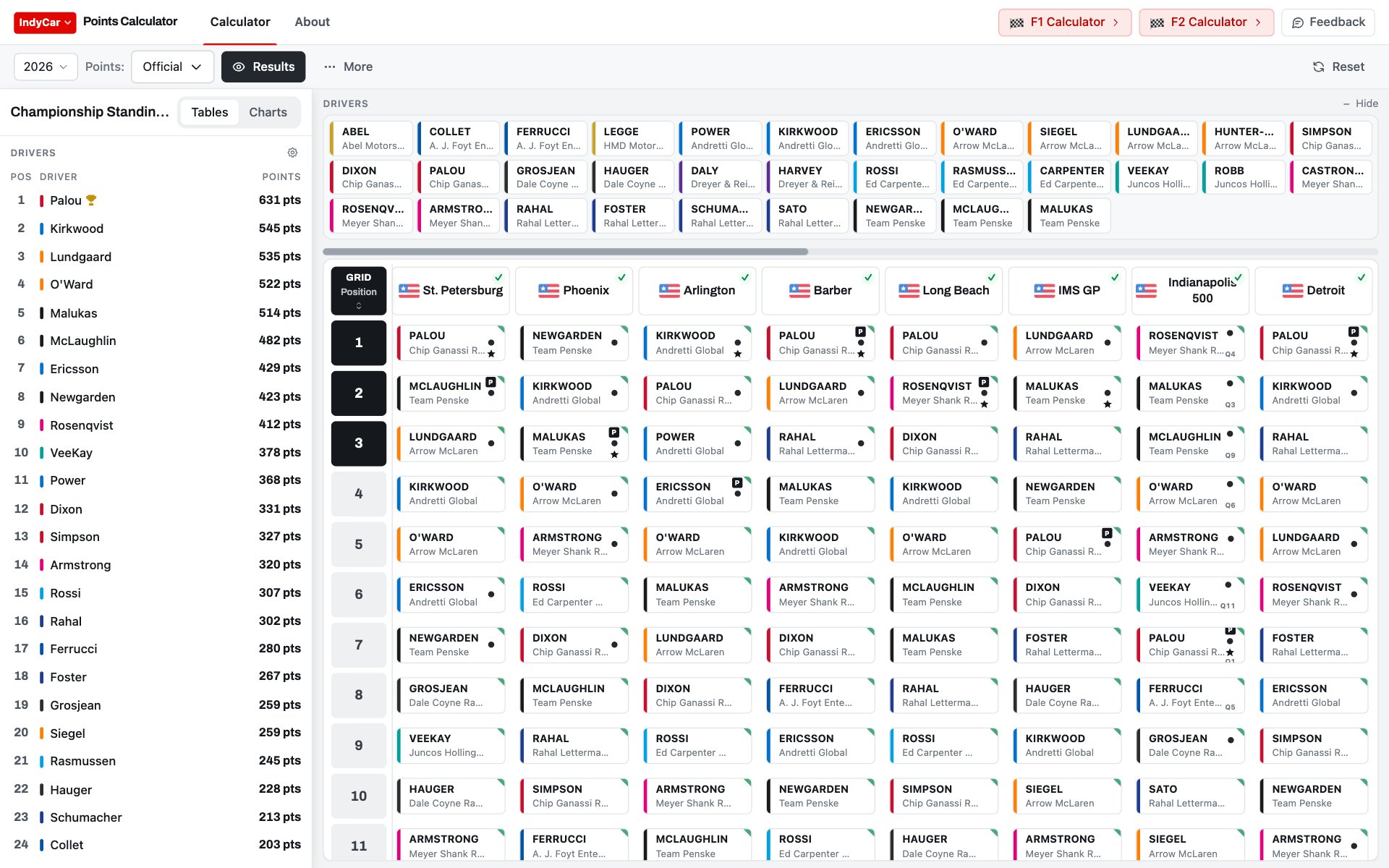
IndyCar Points Calculator lets you predict IndyCar races and see how they change the championship. You drag drivers into finishing positions, give out the pole, laps-led and most-laps-led bonuses, and the drivers’ standings update straight away. Every season since 1996 is included, with the real results filled in.
Free to use, no account needed.
Why use it
It handles the bonus points that make an IndyCar championship hard to work out by hand: pole, leading a lap, leading the most laps, Indy 500 qualifying points, and the double-points races of each era.
Every season from 1996 to 2026 has been checked driver by driver against Wikipedia’s totals. It is free and needs no account.
Results and bonuses
The grid has one column for each race and one row for each finishing position. You drag a driver onto a position, and small marks beside each result show the bonuses for pole, leading a lap and leading the most laps, which you can give out yourself.
In the current rules, finishing places score 50-40-35-32-30-28-26-24-22-20, then one point less for each place down to 6 points for 24th, and 5 points from 25th. Pole is worth 1 point (except at the Indy 500), leading a lap 1 and leading the most laps 2, and Indy 500 qualifying pays 12 points down to 1. Every car in the field scores, and a driver who qualified but didn’t start gets half of last place’s points.
Rules by era
Each season is scored with the rules of its time. From 2014 to 2022 the Indy 500 paid double points, as did the season finale from 2015 to 2019 and the 500-mile races in 2014. From 1998 to 2000 the top three qualifiers got 3, 2 and 1 points, and in 1996 points were multiplied by the number of races entered.
Points penalties are applied as the officials applied them, and drivers level on points are split on most wins, then most second places. The Points menu can also score any season on finishing places alone.
How the seasons are checked
Results come from Wikipedia. Every driver’s total is recomputed from the race results and must equal Wikipedia’s before a season is published. Seasons up to 2018 also use each race’s own article for laps led and starting grids, and German Wikipedia, which marks every driver who led a lap.
During the season, the calculator rereads the season page every few hours, and new results appear once the points check out.
On a phone
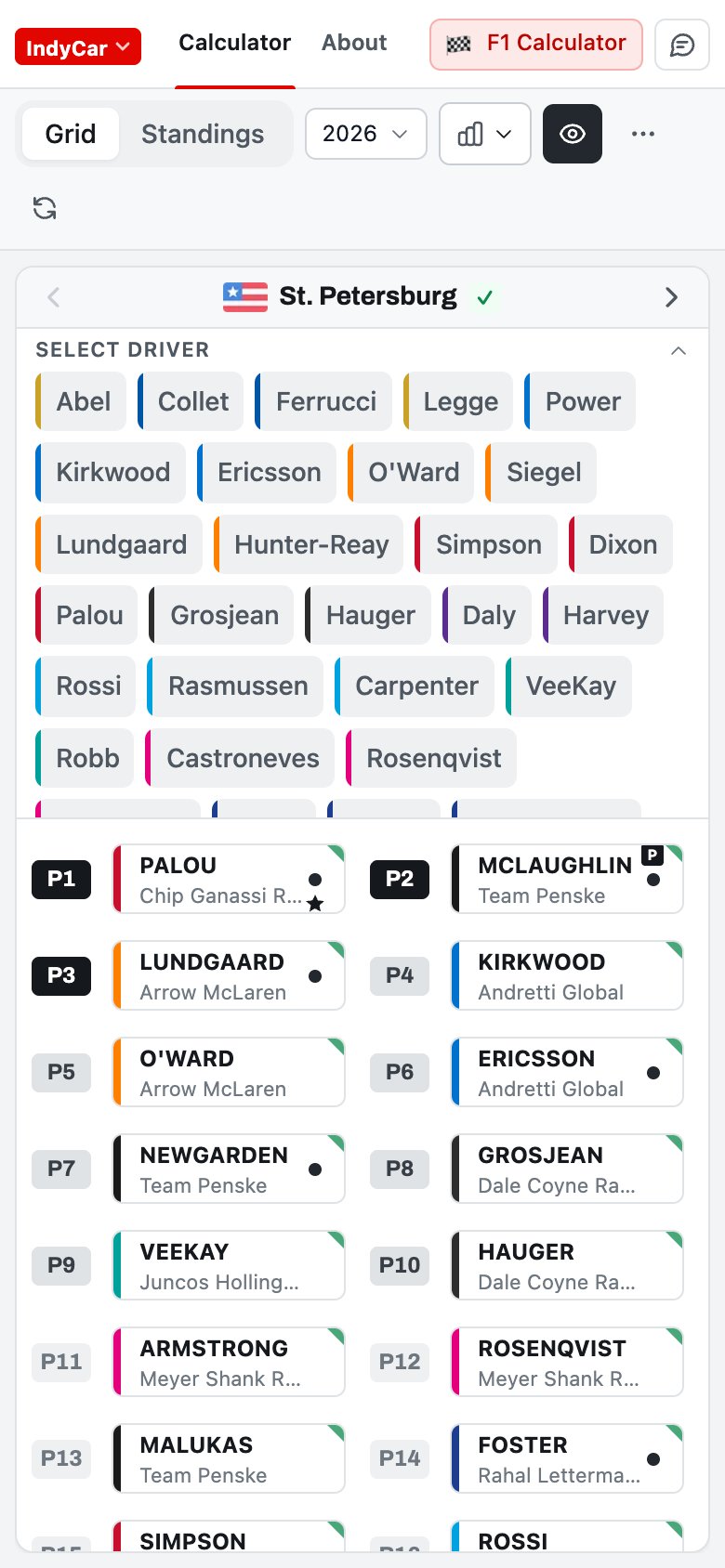
On a phone, the calculator shows one race at a time. The drivers are listed at the top and the positions below them, in two columns. The arrows beside the race name move between races, and the Grid and Standings tabs switch between predicting and viewing the table.
More racing
All racing →