Failing to Train DeBERTa to Detect Patent Antecedent Basis Errors
Patent claims have a simple rule: introduce "a thing" before referring to "the thing." I fine-tuned DeBERTa-v3 on synthetic antecedent basis errors and hit 90% F1 on my test set. Then I evaluated on real USPTO examiner rejections from the PEDANTIC dataset and watched that number collapse to 14.5% F1, 8% recall. The model catches 8 out of 100 real errors. This writeup covers what I built, why it failed, and what the failure reveals about the gap between synthetic and real patent data.
The problem
Antecedent basis errors are one of the most common reasons for 112(b) rejections. They're also one of the most annoying—purely mechanical mistakes that slip through because patent claims get long, dependencies get tangled, and things get edited over time. You introduce "a sensor" in claim 1, then three claims later you write "the detector" meaning the same thing. Or you delete a clause during revision and forget that it was the antecedent for something downstream.
"A device comprising a processor, wherein the controller manages memory." ↑ "the controller" appears out of nowhere—no antecedent
More examples of antecedent basis errors
Ambiguous reference
✗ "a first lever and a second lever... the lever is connected to..."
✓ "a first lever and a second lever... the first lever is connected to..."
When multiple elements share a name, "the lever" is ambiguous.
Inconsistent descriptors
✗ "a lever... the aluminum lever"
✓ "an aluminum lever... the aluminum lever"
Adding a descriptor that wasn't in the antecedent creates uncertainty.
Compound terms
✗ "a video display unit... the display"
✓ "a video display unit... the video display unit"
Can't reference part of a compound term alone without introducing it separately.
Implicit synonyms
✗ "a sensor... the detector"
✓ "a sensor... the sensor"
Even if they mean the same thing, different words require separate antecedents.
Gray area: Morphological changes
? "a controlled stream of fluid... the controlled fluid"
Often acceptable because the scope is "reasonably ascertainable," but some examiners may still flag it.
Not an error: Inherent properties
✓ "a sphere... the outer surface of said sphere"
You don't need to explicitly introduce inherent components. A sphere obviously has an outer surface.
When the USPTO catches it, you get an office action. You pay your attorney to draft a response. The application gets delayed. All for an error so mechanical, so tedious, that checking for it yourself feels almost insulting.

Prior work
Commercial tools
ClaimMaster is a Microsoft Word plugin that parses claims and highlights potential antecedent basis issues: missing antecedents, ambiguous terms, singular/plural mismatches. They describe it as using "natural-language processing technologies" and have recently added LLM integration for drafting and analysis.
Patent Bots is a web-based alternative that highlights terms in green (has antecedent), yellow (warning), or red (missing antecedent).
LexisNexis PatentOptimizer is the enterprise option, checking for antecedent basis and specification support.
Open source
antecedent-check parses claims into noun phrases using Apache OpenNLP. plint is a patent claim linter that requires manually marking up claims with special syntax for new elements and references.
Research
The PEDANTIC dataset from Bosch Research contains 14,000 patent claims annotated with indefiniteness reasons, including antecedent basis errors. They tested logistic regression baselines and LLM agents (Qwen 2.5 32B and 72B) on binary classification of whether a claim is indefinite, with the best model achieving 60.3 AUROC. Antecedent basis was the most common error type, accounting for 36% of all rejections.
Approach
I framed this as token classification: feed the model a claim with its parent claims as context, and have it label each token as the start of an error span, a continuation of one, or clean. I used DeBERTa-v3-base and evaluated against PEDANTIC's test split (885 samples with real examiner-flagged antecedent basis errors).
The training data problem
PEDANTIC has labeled antecedent basis errors, but only ~2,500 training examples. I wanted more data and control over the error types. So I decided to generate synthetic training data.
I started by pulling ~25,000 granted US patents (2019-2024) from Google Patents BigQuery. These are clean, examiner-approved claims with no antecedent basis errors—at least in theory. I parsed out the claim structure, built dependency chains so each dependent claim had its parent claims as context, and ended up with about 370,000 claim-context pairs.
Then I wrote a corruption generator to inject synthetic errors. The idea: take clean claims and break them in ways that create antecedent basis errors, recording exactly which character spans are wrong.
The six corruption types I generate
1. Remove antecedent
Find "a sensor" in context, delete it. Now "the sensor" in the claim is orphaned.
2. Swap determiner
Change "a controller" → "the controller" in the claim where no controller was introduced.
3. Inject orphan
Insert "the processor connected to" from a hardcoded list of 24 common patent nouns.
4. Plural mismatch
"a sensor" in context → "the sensors" in claim. Singular introduced, plural referenced.
5. Partial compound
"a temperature sensor" introduced → "the sensor" referenced. Can't drop the modifier.
6. Ordinal injection
"a first valve" and "a second valve" exist → inject "the third valve".
50/50 split between clean and corrupted examples. The corrupted ones got converted to BIO format (B-ERR for beginning of error span, I-ERR for inside, O for everything else) and fed to DeBERTa.
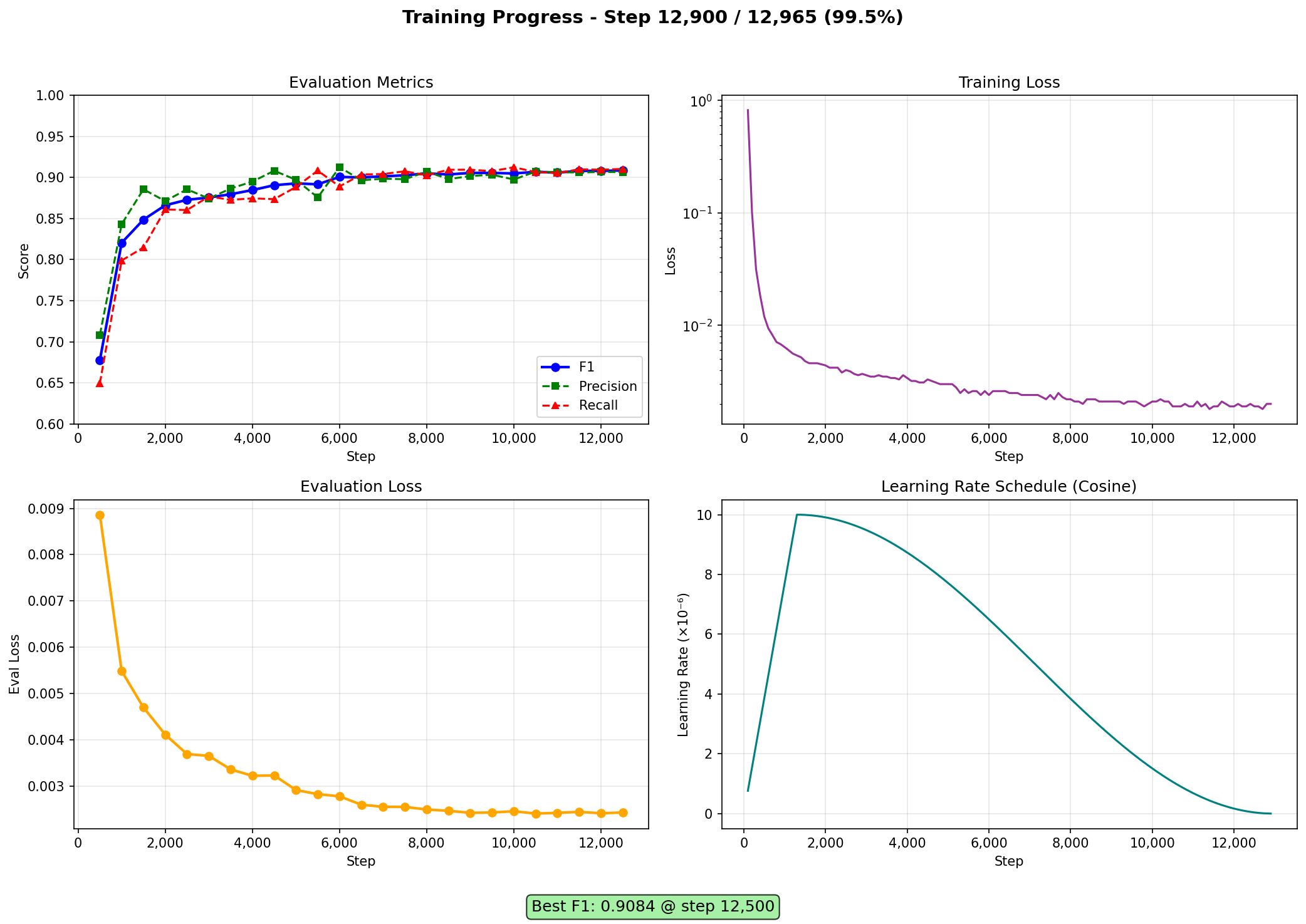
After about 12,500 steps, the model hit 90.84% F1 on my validation set. I was feeling pretty good about it.
Then I tested on real data
The PEDANTIC dataset contains actual USPTO examiner rejections with the error spans labeled by hand. This is the real thing—885 test samples where examiners flagged antecedent basis issues in actual patent applications.
Out of the box, my model hit 5% F1. That 90% on synthetic data? Gone. But before giving up, I wanted to understand what was actually happening inside. The model outputs a confidence score for each token—how sure is it that this word is part of an error? By default, it only flags tokens where it's more than 50% confident. What if I lowered that bar?
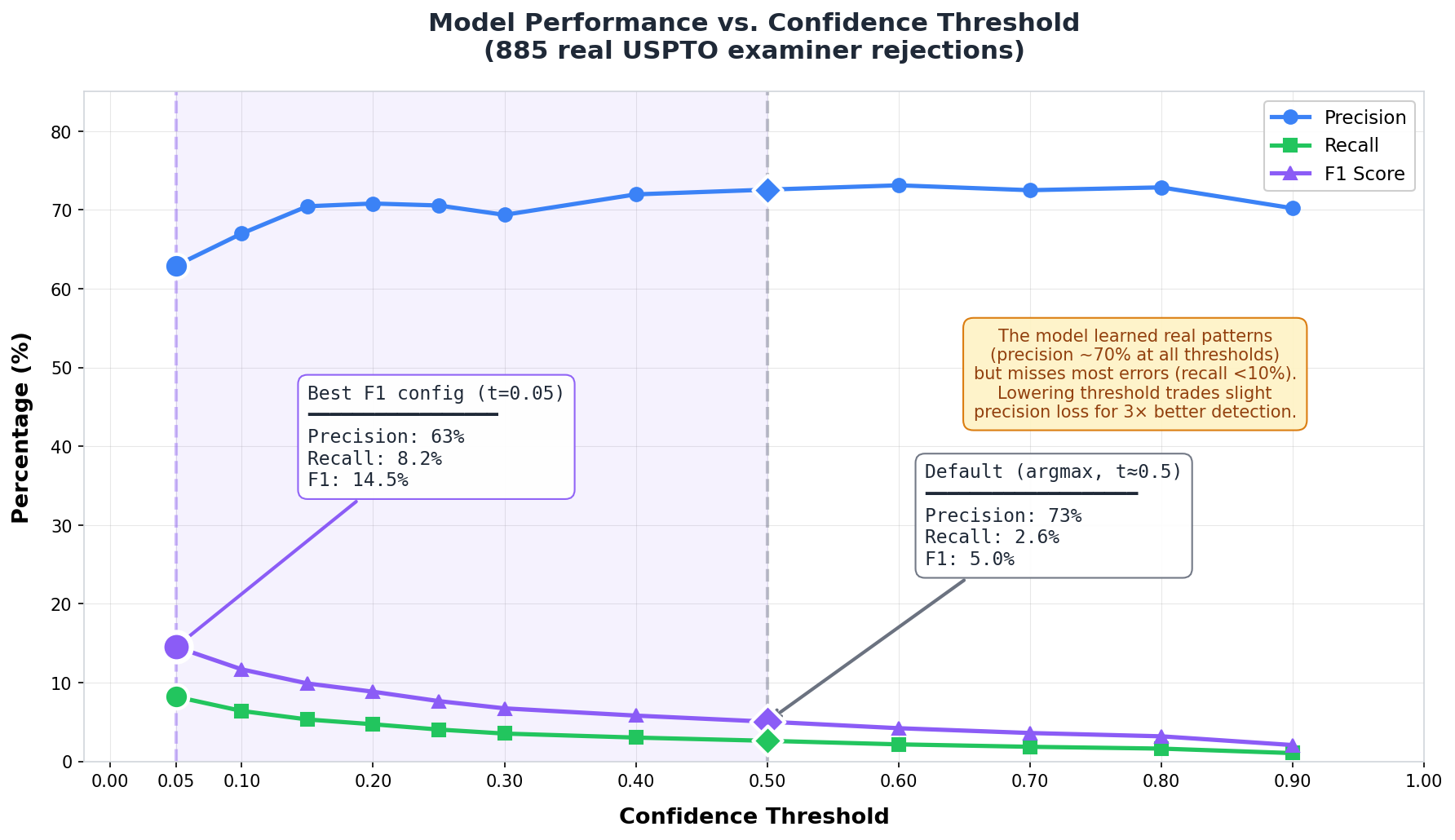
Look at the blue line. Precision barely moves—stays around 70% no matter what threshold I pick. That's interesting. It means the model actually learned something real. When it speaks up, it's right about two-thirds of the time, whether I make it cautious or aggressive.
The green line is the problem. At the default threshold, recall is 2.6%—catching almost nothing. Crank the threshold down to 0.05, and recall triples to 8.2%. Still bad, but less bad. F1 goes from 5% to 14.5%. I'll take it.
So the model isn't broken. It learned patterns that transfer to real data—just not very many of them. The synthetic corruption I generated covers maybe 8% of what USPTO examiners actually flag. The other 92%? Patterns I didn't think to simulate.
Exploring the data
Before trying to fix anything, I wanted to understand what's actually in PEDANTIC and what my model sees. I ran every test sample through the model at threshold 0.05 and categorized every prediction.
What the model catches
Of the 258 true positives, 92% start with "the"—phrases like "the user", "the source profile", "the matrix". This makes sense. My synthetic training data generates errors by swapping "a X" to "the X", so the model learned to flag definite articles that lack antecedents. When it sees "the controller" and can't find "a controller" earlier in the context, it speaks up.
What it misses
The 2,883 false negatives tell a different story. Only 38% start with "the". The rest?
"widgets", "pattern", "text content" 37% of all errors. The noun is used without "the" or "a" but still lacks proper introduction.
"said widget", "said data" Patent-speak for "the". My model catches almost none of these despite 30% augmentation in training.
"a location of the occluded area" The error is "the occluded area" but PEDANTIC marks the whole phrase. Different annotation granularity.
"it" 20 cases. Never in my training data because I focused on noun phrases.
False positives
The 152 false positives are mostly patent boilerplate: "The method of claim 8", "The system", "The apparatus". These always have antecedents—"method" refers to the claim itself, "system" to whatever was introduced in claim 1. The model doesn't understand claim structure, just surface patterns.
Data quality
Some PEDANTIC annotations look like parsing artifacts. I found dozens of instances of "d widgets" and "idgets"—clearly broken spans from the word "widgets". A small percentage of false negatives have suspicious patterns: spans starting with spaces, single characters, or truncated words. Not a huge problem, but worth noting.
The gap
Now the picture comes together. Go back to those six corruption types I wrote—every single one produces errors starting with "the" or "said". That's all the model ever saw during training.
But real examiner rejections are messier. PEDANTIC breaks down like this:
| Pattern | % of PEDANTIC | Recall | Training |
|---|---|---|---|
| "the X" | 42.0% | 16.2% | trained |
| bare nouns | 37.3% | 1.0% | never |
| embedded "the" | 9.6% | 9.3% | never* |
| "a/an X" phrases | 6.2% | 1.0% | never |
| "said X" | 4.3% | 1.5% | 30% aug |
| pronouns | 0.6% | 0.0% | never |
* Embedded patterns get partial credit when our "the X" detection overlaps with the annotated span
But wait—if I trained on "the X" patterns, why is recall only 16%? Where did the other 84% go?
Digging into the 84%
I dug into the model's actual predictions and found bugs in my corruption logic.
Distribution mismatch on context. 51% of missed "the X" errors are in independent claims (no parent context). My training data has 18% without context—not zero, but the distribution is off. The model learned to rely heavily on cross-referencing "the X" against "a X" in context. When context is missing or sparse, it's less confident.
I trained on wrong labels. Here's the bug: 7% of my training errors are "The X of claim N" patterns—things like "The method of claim 1, wherein...". These should never be errors. The phrase "of claim 1" explicitly provides the antecedent. But my remove_antecedent corruption doesn't understand this. It sees "a method" in context, "the method" in the claim, removes "a method", and labels "The method" as orphaned. Wrong.
This created spurious patterns. 10.8% of error tokens in my training data appear within 3 tokens after the [SEP] separator—right at the claim start. The model learned "claim start → likely error". On real data, it puts ~0.3 probability on [SEP] and claim-start boilerplate. Actual errors also get ~0.3 probability. The model can't distinguish real errors from the noise I accidentally taught it.
Real errors are more subtle. My synthetic training creates obvious cases—I delete "a sensor" from context, making "the sensor" clearly orphaned. But 17% of PEDANTIC's "the X" errors have an "a X" that does exist somewhere earlier. The examiner flagged it anyway because the reference was ambiguous, or referred to something different, or had a scope issue. I never generated these nuanced cases.
The false positives
The 152 false positives are almost all patent boilerplate: "the method", "the apparatus", "the system". Now I know why—I literally trained the model to flag these. Those 7% wrong labels taught it that claim-start phrases are errors. The model is doing exactly what I trained it to do. I just trained it wrong.
The real gap
90% F1 on synthetic data, 14.5% on real data. The gap is my corruption logic. I accidentally trained the model on wrong labels, created spurious patterns around [SEP] and claim-starts, and never generated the subtle ambiguity cases that real examiners flag. The model architecture is fine. My training data was broken.
Future work
The model architecture isn't the problem—DeBERTa learned exactly what I taught it. The corruption logic is what's broken. There are a few clear directions to try:
Fix the bugs. Filter out "The X of claim N" patterns from error labels. Add explicit negative examples where boilerplate phrases like "The method of claim 1" are labeled as NOT errors. Rebalance the context distribution to match PEDANTIC (more independent claims, fewer dependent).
Cover more patterns. 37% of real errors are bare nouns—"widgets", "pattern", "text content"—and I never generated any. Add corruptions that reference bare nouns without introduction. Generate "said X" errors more aggressively (30% augmentation wasn't enough for 1.5% recall). Add pronoun cases.
Generate harder cases. Right now I create obvious errors—delete "a sensor" and "the sensor" is clearly orphaned. But 17% of real errors have an antecedent that exists but is ambiguous, refers to something different, or has scope issues. This probably requires either manual curation or a smarter generation strategy that intentionally creates near-miss patterns.
Or skip synthetic generation entirely and fine-tune on PEDANTIC's training split. It's smaller (only ~2,500 antecedent basis examples vs my 185,000), but it's real data with real annotation patterns. The distribution would match by construction.
January 2025